Acknowledgments
GRANT_NUMBER: 2600105 – Biogenic hydrogen production under geological carbon storage conditions (PI: Vilcaez, co-PI: Elshahed)
GRANT_NUMBER: 2041648 – Pore-scale machine-learning modeling of flow and transport properties of carbonate rocks (PI: Vilcaez)
GRANT_NUMBER: 2200036 – Removal of metals from produced water by dolomite (PI: Vilcaez)
GRANT_NUMBER: 2020OK197B – A new dolomite filtration technology to remove heavy metals and NORM from produced water (PI: Vilcaez)
GRANT_NUMBER: 24369-BO – Energy transition and mining of critical minerals for energy in Bolivia

GRANT_NUMBER: 1-152421 – Supercritical CO₂–Enhanced Microbial Oil Removal Integrated with Dolomite Mediated Metals Recovery from Produced Water (PI: Vilcaez)

Topics
Water-Energy-CO2 nexus
1. Carbon capture and utilization in depleted oil reservoirs
2. Biogenic H2 production in depleted oil reservoirs used for geological carbon storage
3. Petroleum produced water treatment and disposal
4. Mining of metals from petroleum produced water
Machine learning & Environmental data analysis
1. Pore-scale modeling of petrophysical properties
2. Numerical optimization and uncertainty analysis
3. Geostatistical analysis of groundwater and hydrocarbon reservoirs
Mathematical modeling and simulation of multiphase reactive transport processes
1. Groundwater flow
2. Enhanced oil recovery
3. Geological CO2 storage
4. Heap and underground leaching of minerals
5. Transport and transformation of pollutants in underground water
Petroleum and mineral biotechnology
1. Microbial enhanced hydrocarbon recovery
2. Biogenic CO2-recycling to CH4
3. Bio & hydrometallurgy
4. Biological treatment of waters
Hydrothermal technology
1. Upgrading of heavy oil with supercritical fluids
2. Hydrothermal hydrogen generation
Current projects
Pore-scale machine learning modeling of flow properties of carbonate rocks

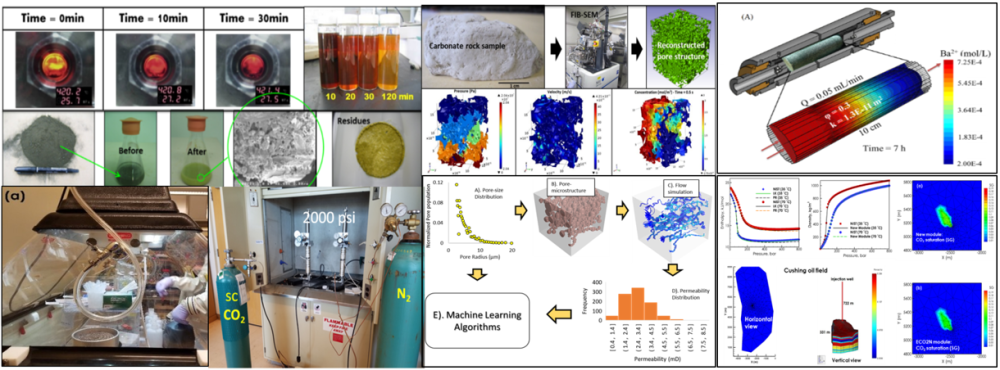
Carbonate rocks are characterized by complex pore microstructures and strong heterogeneity. The goal of this research project is to develop a predictive understanding of the relationship between the pore microstructure and flow properties of carbonate reservoir rocks. To reach this goal, we are using a novel approach that consists of the reconstruction of thousands of pore microstructures of the same and pore size distribution and overall porosity but different stochastic pore connectivity (just like it happens in nature). The input data is pore size distribution curves obtained from nuclear magnetic resonance (NMR) measurements and pore geometries obtained from scanning electron microscopy (SEM) analysis. This property of the reconstructed pore microstructures is enabling us 1) to focus on the effect of pore connectivity and its stochastic nature on the flow properties of carbonate reservoir rocks, and 2) train machine learning models to predict flow properties (e.g., permeability and tortuosity) of carbonate rates from pore size distribution, geometry, and porosity data.
Biogenic hydrogen production from oil hydrocarbons in geological carbon storage sites

On average 2/3 of the oil remains in oil reservoirs after primary and secondary recovery operations. This constitutes a huge volume of oil that that we are aiming to recover in the form of hydrogen. We have discovered a process where the combined supply of protein-rich matter and supercritical carbon dioxide to petroleum produced water stimulates the biogenic production of hydrogen from crude oil by indigenous fermentative microbes generally present in oil formation waters. This process of hydrogen production couples geological carbon storage, produced water disposal, and hydrogen production in depleted oil reservoirs. Therefore, this technology will not have negative environmental impacts, conversely, the implementation of this new process has the potentiality to solve environmental and energy issues related to atmospheric pollution with carbon dioxide, risk of freshwater resources contamination with petroleum produced water, and depletion of energy resources. Moreover, this hydrogen production process is inexpensive compared to other surface technologies that require complex and expensive infrastructure.This process will use depleted oil reservoirs as the reaction vessel for hydrogen production.
Computational modeling and simulation of geological carbon capture, utilization, and storage (CCUS) under biotic conditions

Available software to simulate geological carbon and hydrogen storage does not account for the effect of microbial activity on the fate of CO2 and/or H2. The goal this research project is to assess the long-term physical, chemical, and microbiological fate of CO2 and H2 in deep saline aquifers and depleted oil reservoirs injected with CO2 or H2 where the availability of nutrients and/or the co-injection of produced water supplied with nutrients can result in the microbial conversion of CO2 and residual crude oil to CH4 and/or H2 . To this aim, we have developed a new TOUGHREACT module named CO2Bio. TOUGHREACT-CO2Bio can simulate the multicomponent reactive flow of CO2-CH4-H2S-H2 gas mixtures and brine in deep saline aquifers and depleted oil reservoirs under biotic conditions. The next step is to account for the mobility the crude oil due to pressure restoration and/or viscosity reduction.
Petroleum produced water treatment and disposal into deep saline aquifers.

High levels of dissolved oil hydrocarbons and toxic metals (e.g., Ba, Sr, Cd, Pb, and As ) in produced water hinders the utilization of conventional membrane filtration technologies to treat produced water for its beneficial use (e.g. integration into industrial and agricultural use) and/or safe disposal. One of he goals of this research is 1) to assess the feasibility of removing dissolved oil from produced water by stimulating the activity of indigenous oil degrading microbial communities, and 2) to determine the potentiality of removing toxic metals and naturally occurring radioactive materials (NORM) from produced water by using filters made of dolomite grains. The potentiality of these new treatment methods of produced water lays on our following findings and practical considerations: 1) produced harbors anaerobic microbial communities that are well adapted to high salinity conditions, 2) dolomite represent a superior sorption capacity for toxic metals than other natural sorption materials, 3) produced storage tanks can be readily adapted to operate as anaerobic bioreactors, and 4) high purity dolomite is abundant in the Arbuckle Group of Oklahoma and Kansas where oil production activity is high. The mobility and transport of toxic metals in deep saline aquifers where petroleum produced water is commonly disposed is unknown. The other goal of this research project is to provide new knowledge and computational tools to predict the chemical and physical fate of toxic metals in deep dolomite saline aquifers. The established combined experimental and computational approach can be used to design effective injection schemes to prevent the contamination of underground sources of drinking water (USDW) due to the migration of produced water through natural fractures/faults and failures of abandoned oil wells.
Mining of critical metals from oil/natural gas produced water

Oil and natural gas produced waters contain high concentations of Rare Earth Elements (REEs), Critical Minerals (CMs), and Elements of Interest (EOIs). We are studying a process to recover REEs, CMs, and EOIs from produced water. The process consists of using dolomite filters made of compressed dolomite grains as source of alkalinity (carbonate ions) as well as sorption and precipitation phase to recover REEs, CMs, and EOIs in the form of carbonate mineral precipitates. Different from processes that rely on evaporation to concentrate REEs, CMs, and EOIs in solution such that they can precipitate with carbonate ions sourced from added soda ash, for instance, the proposed dolomite filtration process enables the precipitation of carbonate minerals by concentrating metals by sorption reactions on the surface of dolomite where carbonate ions are generated. Our preliminary results using synthetic produced water have shown that high concentrations of metals (100 mg/L) such as Ba, Sr, Cd, Pb, and As can be recovered from produced water as carbonate minerals from produced water.
Selected past projects
Pore-scale simulations of flow properties of reservoir rocks

Besides a consistent kinetic model for the dissolution/precipitation and aqueous phase reactions of solutes, and a suitable equation of state (EOS) to represent the solubility of gases in the aqueous phase, the use of multiphase reactive transport simulation programs needs of accurate information on the flow properties of the reservoir rock. We are using FIB-SEM techniques in combination with the capabilities of CFD simulation programs (COMSOL Multiphysics) to reconstruct the microstructure of reservoir rocks and conduct pore-scale simulations of flow properties of reservoir rocks at the nano-scale level.
Microbial enhanced hydrocarbon oil recovery (MEHR) through selective plugging

Microbial growth and their biogeochemical reaction products can lead to significant changes in porosity and permeability of reservoir rocks. Reduction in porosity and permeability may be caused by the growth of microbes and the deposition of extra-polymeric substances (EPS) in the void space of rocks, whereas an increase in porosity and permeability may occur due to the dissolution of rocks accelerated by produced organic acids during microbial growth. The objective of this research is to develop reactive transport models to mechanistically understand the complex interplay between microbial growth, EPS production, and the interactions between the microbial byproducts and rocks. This research is expected to help in identifying the controlling factors that govern the selective plugging of oil/gas reservoirs to enhance hydrocarbon recovery.
Biodegradation of spilled oil in sea water
After or during the oil spill it is of common practice to introduce chemical dispersants near the spill region. Under these conditions, spilled oil can not only dissolve in sea water, but also form oil droplets. Although large oil droplets can arise to the sea surface due to the buoyancy effect, previous studies suggest that small oil droplets would not rise to the surface but remain in underwater. Thus, spilled oil can exist in both dissolved form and as oil droplets in deep water. In order to be able to predict the biodegradation rate of the fraction of oil in the form of droplets, a new model for the biodegradation kinetics of dispersed oil droplets has been developed. The next step is to couple flow and transport processes with biodegradation to explicitly simulate the evolution of oil composition with time to more accurately represent what occurs after oil spills.
Heavy oil upgrading with supercritical water

If heavy crude oil resources are to be exploited, efficient, environmentally benign and inexpensive upgrade technologies are desirable. To fulfill these conditions, upgrading without coke formation is required, and supercritical water processing is an attractive option to achieve this aim. Specific features of potential supercritical water processes have been reported: the yield of asphaltenes and resins can be reduced; the fraction of aromatics is reduced, while the yield of saturated compounds is increased; in addition the removal of sulfur, nitrogen and metal fractions is possible. These results suggest that supercritical water serves both as a reaction medium, and a reactive species, and thus the supercritical reaction atmosphere may provide effective upgrading conditions for heavy oil without the need for a catalyst.
Heap and underground leaching of minerals

The main objective of this research is the elucidation of the catalytic effect of thermophiles in leaching sulfide minerals, various new findings are contributing to a better understanding of interactions among chemical, physicochemical and microbiological factors. In order to bridge laboratory results and field applications, novel kinetic models and advanced mathematical models to assess the auto-thermal performance of heap and underground leaching systems are being developed. The methodologies employed in this research will be used to assess the impact of microbial activity on the leaching of heavy metals from shale gas rocks at deep geological formation conditions.

